Joseph A.
Santo holds a Doctor of Musical Arts degree in Composition from The Catholic University of America where he was Assistant
Dean for Academics and for Graduate Studies at the Benjamin T. Rome School of Music from 2002 to 2019. The
composer has been active in music education and a composer throughout his professional career. He has been the recipient of ASCAPlus Awards and holds active membership in The College Music Society, The American
Music Center, the Society of Composers, Inc., and the National Association for Music Education. He has written in a variety of genres, from solo works to chamber works to large scale compositions, including Vísperas de la Santa Cruz, a concert Vespers for soloists,
chorus, and orchestra, using texts in Latin, Spanish, and indigenous Latin American languages, which received its world premiere on April 3, 2011 in Washington, D.C. The work was the recipient of a generous grant from
the Composer Assistance Program of the American Music Center. His Concerto
for Piano and Orchestra, premiered in 2000, was also the recipient of a generous grant
from The American Music Center. Song cycle for soprano and piano, entitled Rimas sacras, on medieval to 16th century Spanish texts, was
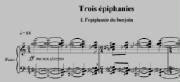
premiered in 2003. Trois épiphanies,
a three-movement work for piano solo, premiered in 2004, was chosen for performance at the 2006 Mid-Atlantic Regional Conference
of the College Music Society. Prólogo y Canto for piano trio was performed at Weill Hall of Carnegie Hall, November 2010, as part of a concert series sponsored
by the La Gesse Foundation. The composer’s lifelong interest in languages
has given the stimulus for music using texts in Latin, Anglo-Saxon, medieval and modern French, Neapolitan, and Spanish, among
others. Lux refulget for choir and orchestra was
premiered in 2012 by the choruses and orchestra of The Catholic University of America. Život v pravdě (Life in Truth) for narrator and chamber orchestra,
a project in collaboration with the Embassy of the Czech Republic to honor President Václav Havel, was premiered in
2013 by the Trinity Chamber Orchestra, Washintgon, D.C. Trio for flute, violoncello, and piano was premiered in 2018, as was Quintet
for Brass. Malachey Elyon, for recorded voices, tenor solo,
and chamber orchestra and chorus is described in the "about selected works" section of this website and in the catalog
entry. It was premiered in 2008 and was again performed November 16, 2018 as part of The Catholic University of America's
commemoration of the 80th anniversary of Kristallnacht. The conposer's most recent
works include a sacred chamber opera entitled El
Divino Orfeo, on a text of the same title by Don Pedro Calderón de la Barca; an
SATB a cappella work entitled Hymn to the Almighty, using Greek texts; Sonata for chamber orchestra; Canticum Zachariae for SATB chorus and chamber orchestra; Tres Historiae
sancti Evangelii secundum Ioannem for vocal
soloists, SATB chorus, and chamber ensemble; Concerto for Violin, Viola, and Orchestra; Istampitte for orchestra; Symphonia for orchestra; Ballade for symphonic band; Symphonia for large orchestra. Nightsong for flute and Bb clarinet, which was performed in March 2023 at the Mid-Atlantic Chapter of The
College Music Society; Deeis: to eikonídio ton eptá plaisíon for large
orchestra; Cantica post lectiones ad
vigiliam paschalem in nocte sancta for SATB a cappella choir (with English texts: Canticles sung after the reading of the
prophecies at the great vigil of Easter, for SATB a cappella choir); El Alba de Titon ya se partίa, for symphonic
band; Missa pro pace, a concert
work for SATB chorus and orchestra; Quattro Sonetti di Michelangelo, for baritone voice and piano/baritone voice and chamber orchestra; Freedoms Four for flute (piccolo, alto flute) and piano. His complete Catalog of Works appears on this website.